Construction and demolition debris collection in Bradfordsville addresses structural waste accumulations that municipal garbage routes exclude. Outlying regions along the Rolling Fork Valley, Dry Fork, and the Liberty…
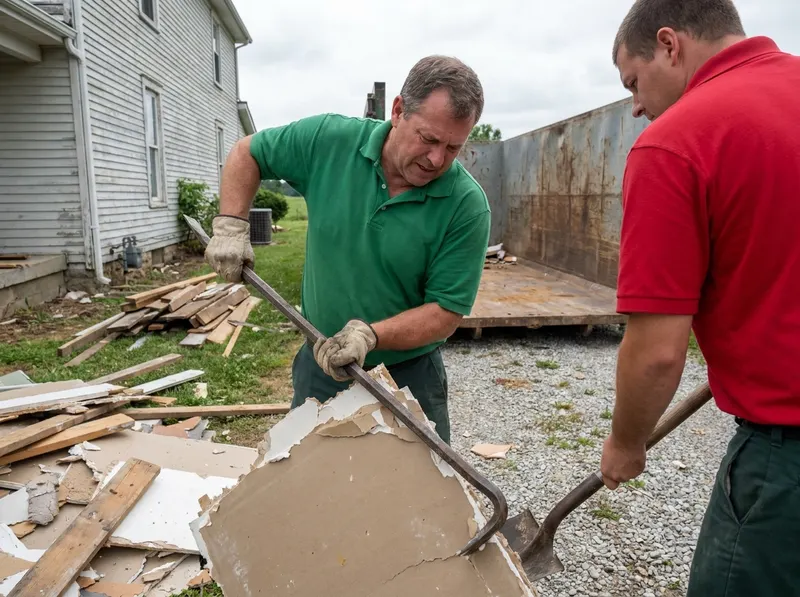
Construction and demolition debris collection in Bradfordsville addresses structural waste accumulations that municipal garbage routes exclude. Outlying regions along the Rolling Fork Valley, Dry Fork, and the Liberty Pike Corridor frequently lack roadside bulk services, leaving property managers with piles of framing timber, lath, plaster, and metal offcuts. A dedicated open-top roll-off keeps job sites clear, preventing field contamination and eliminating the multiple trailer runs otherwise required to reach the Marion County Transfer Station. The service provides driveway-safe boards beneath the container rollers to protect rural asphalt and packed gravel paths from high-tonnage pressure.
Choosing the appropriate disposal strategy depends on material weight and project scale. When handling dense materials like asphalt shingles from a roof tear-off near Brush Creek Area or broken slab sections from Purdy Bottom farm structures, a compact 10-yard or 15-yard container prevents exceeding legal road weight limits. Larger 20-yard and 30-yard roll-offs accommodate bulky, lower-density items such as drywall sheets, structural trusses, and cabinetry from whole-home remodels in Downtown Bradfordsville or Old Bradfordsville Settlement. The operational trade-off centers on spatial footprint versus tonnage: larger containers require wider turning radiuses on narrow rural lanes, while smaller containers accept denser loads but require careful packing of dimensional lumber to avoid overtopping the sidewalls.
Hauling operations account for local geographical constraints, including low-hanging utility branches and narrow low-water crossings near the Rolling Fork River. Step one involves identifying a level 40-foot staging lane on stable gravel or dry earth. Step two covers container delivery, positioned to allow direct swing-door access for heavy materials. Step three consists of staging and filling the container below the top rim line. Step four concludes with automated tarping, winch loading, and legal transport to state-permitted disposal facilities. Weight slips determine final processing assessments if tonnage exceeds the base threshold included in the initial booking.
Every job gets a firm, written price after a free on-site visit.
Tell us about your construction & demolition debris collection job in Bradfordsville and we'll send a clear, written quote, usually the same day.
 Parkside Dumpster Rental